

Introduction: Rethinking the Energy Debate
With more than two decades of experience in the electricity sector across various Latin American countries, and having closely observed the profound transformation driven by initiatives such as the Kingdom of Saudi Arabia’s Vision 2030, I believe that the debate on the energy transition in Bolivia requires a more pragmatic approach. It is necessary to move away from ideological discourse and focus on the technical, economic, and geopolitical realities facing the country.
The Bolivian case deserves special attention because it could become a model for other nations in the region facing similar challenges. This strategic vision was recently presented during FINERGY through presentations by Mario Larrain (president of ENDE), Carlos Peláez (international specialist in energy regulation), and José Alejandro Durán (president of the CRE). Their perspectives reveal an approach different from what is typically heard in Latin American energy debates.
The Diversification Strategy: Specific Figures
The roadmap defined by ENDE for the 2026–2033 period calls for the addition of more than 3,000 MW from new hydroelectric projects for the National Interconnected System (SIN). In addition, solar and wind initiatives could add nearly 1,000 MW of installed capacity.
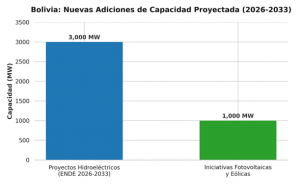
These figures are significant, but the plan also acknowledges an inescapable reality: thermal power plants will continue to play a strategic role in national energy security. Their operation remains closely linked to the hydrocarbon sector and, in particular, to the availability of natural gas, a resource that remains one of the pillars of Bolivia’s electricity system.
The Critical Challenge: Dwindling Hydrocarbon Reserves
This is precisely where one of the country’s main challenges arises. Bolivia faces a progressive decline in its hydrocarbon reserves and urgently needs new investments in exploration and production to reverse this trend. If it fails to do so, it risks becoming, in the medium term, an importer of energy resources from markets that were historically its main export destinations.
This reality forces us to rethink fundamental concepts that are often used indiscriminately in public debate. Strictly speaking, Bolivia is not undergoing an energy transition in the classical sense of the term. A transition implies the gradual replacement of conventional technologies with new sources capable of assuming a predominant role within the energy mix.
Transition vs. Diversification: A Strategic Distinction
What we are currently seeing in Bolivia is a different process: a gradual diversification of power generation sources. When renewable energy accounts for about 30% of projected installed capacity and traditional sources remain essential to ensuring the reliability of the system, it is more accurate to speak of diversification rather than energy substitution.
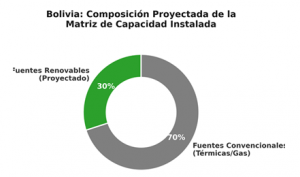
The difference is not merely semantic; it is strategic. This conceptual distinction shapes public policy, investment decisions, and expectations for the sector’s development. A transition implies abandonment; diversification implies integrated growth. Bolivia is on the second path.
Modern Regulatory Framework: The New Electricity Act
In this context, the draft of the new Electricity Act takes on particular significance. Thanks to the work led by Carlos Peláez and his team, a regulatory proposal has been developed that preserves the fundamental pillars of the current regulatory framework while incorporating modern tools designed to facilitate the implementation of the energy diversification strategy promoted by ENDE.
Among the most notable innovations are:
- Public-Private Partnerships (PPPs): Mechanisms that allow for the sharing of risks and responsibilities between the government and private investors, widely used internationally.
- Energy Auction Mechanisms: Instruments designed to attract investment, promote competition, and optimize resource allocation.
These tools could mark the beginning of a new era for Bolivia’s electricity sector, characterized by greater joint participation by the government and private investment.
Legal Certainty: The Foundation for Investment
The proposed legislation provides for the subsequent development of specific regulations through executive orders and the consolidation of a legal framework designed to strengthen legal certainty and investment protection. This effort, currently being led by the Ministry of Development Planning, is crucial for mobilizing the capital needed to carry out the projects required in the coming decades.
The existence of clear and predictable rules is the foundation upon which investor confidence is built. Without this element, no energy diversification strategy can succeed.
Private Confidence: Evidence of Viability
Another aspect worth highlighting is the confidence that current private players in the National Interconnected System have in the sector’s future. Companies such as CRE continue to invest in infrastructure, expanding electricity service coverage and supporting the growth of regions experiencing significant economic and demographic expansion.
As José Alejandro Durán noted, the so-called energy transition has ultimately materialized in practice as an ongoing process of diversification underpinned by technological innovation, operational efficiency, and continuous investment. A concrete example is the Río Seco photovoltaic plant, located approximately 110 kilometers from Santa Cruz de la Sierra, considered one of the most efficient solar facilities in the country.
Social and Regional Impact: Beyond Power Generation
In addition to these advances, there are projects with profound social and economic impact, such as the electrical interconnection of all provinces in the department of Santa Cruz, including the recent connection of Ángel Sandóval Province. This achievement represents a milestone in the CRE’s 64-year history and reaffirms its commitment to the development of Bolivia’s most dynamic region and the one with the highest economic growth.
Electrification is not just a technical issue; it is a catalyst for economic and social development. When electricity coverage expands, opportunities open up for small and medium-sized enterprises, the quality of life in communities improves, and the infrastructure foundation for future growth is established.
The Energy Mix of the Future: Balance and Resilience
The facts are clear: Bolivia is not abandoning one energy source to replace it with another. It is building a broader, more resilient, and more balanced energy mix, capable of combining:
• Hydropower: Harnessing the country’s hydropower potential
• Renewable Energy: Gradually incorporating solar and wind power
• Thermal Generation: Maintaining the system’s reliability
This combination simultaneously ensures security of supply, operational stability, and economic competitiveness. It is not a matter of choosing between sources; it is a matter of integrating them intelligently.
Reframing the Debate: From the End to the Means
Therefore, the discussion should no longer focus exclusively on the energy transition as an end in itself. The real challenge lies in accelerating and consolidating smart energy diversification that enables:
- Attracting investment: Through clear and secure regulatory frameworks
- Strengthening national energy security: By diversifying sources and reducing dependencies
- Sustaining long-term economic growth: By ensuring a reliable and competitive supply
Conclusion: The Bolivian Lesson for Latin America
Perhaps this is the main contribution Bolivia can make to the Latin American energy debate today: demonstrating that, before replacing energy sources, it is necessary to diversify; and that sustainability is only possible when built on solid technical, economic, and regulatory foundations.
In a context of global transformation, where energy is a critical factor in competitiveness, the Bolivian model offers a pragmatic and realistic alternative. It is not an ideological model; it is a model based on facts, figures, and a deep understanding of local realities.
For the region’s leaders, the question is no longer whether to transition, but how to diversify intelligently. Bolivia is leading the way.
Endnotes
About the author: This perspective is based on more than two decades of experience in the Latin American electricity sector, including observations of international models of energy transition and sectoral regulation.
Key figures mentioned:
• Mario Larrain, President of ENDE
• Carlos Peláez, Energy Regulation Specialist
• José Alejandro Durán, President of the CRE
Featured event: FINERGY (Energy Forum)